
Lamar County Civil Docket Searches
Lamar County routes its civil docket lookup through Online Services. That page lists a “Lamar County Judicial Records Search.” It runs on Tyler Odyssey Public Access. The County Clerk page labels the same route “Criminal and Civil Case Information.” In September 2026 the direct public portal returned an access error. That says nothing about whether civil records exist. It just means this. The portal's party-role filters, document views, export tools, and fee prompts can't be described in detail yet.
Search with the full cause number when you have it. No cause number? Try a party name, then spelling variations. The County Clerk's Tyler disclaimer compares its index to a library catalogue. It warns the index is not a certified court record. It also notes that images can go dark during backups. Match any result to the court and case style. Check the filing date too before you rely on it.
- Identify the court on the latest notice or filed paper.
- Search the county link by cause number, then by name if needed.
- Try re:SearchTX for statewide electronic filings.
- Ask the responsible clerk for the precise document or a certified copy.
District Clerk or County Clerk?
Civil records follow the court, and Lamar County has two elected clerk offices. District Clerk Shawntel Golden holds the files of the 6th and 62nd District Courts. These handle larger or specialized civil actions. Family cases fall within their jurisdiction too. County Clerk Ruth Sisson keeps County Court and County Court at Law records. Those cover county-level civil, probate, and related matters. Justice Courts hold their own small-claims, debt-claim, and eviction files. So the court named in the paperwork tells you which clerk to call.
District Clerk
119 N. Main Street, Paris, Texas 75460
903-737-2427
Weekdays, 8:00 a.m. to noon and 1:00 to 4:30 p.m.
County Clerk
119 N. Main Street, Paris, Texas 75460
903-737-2420
Weekdays, 8:00 a.m. to 4:30 p.m., closed noon to 1:00 p.m.
Both clerks share one courthouse address. That trips people up. File a paper with the District Clerk. That does not make it available from the County Clerk next door. Give the court and cause number when you call. Neither clerk page promises email copies of ordinary documents or a fixed turnaround. Confirm the current submission and payment method before you send anything.
Civil Dockets: What They Show
Think of a civil docket as a timeline of case activity. What appears depends on the fields the court supplies. A docket can list the cause number, case style, court, filing date, and the parties and their roles. It may also show event dates and event types. Document titles, attorney, settings, status, disposition, and post-judgment activity can appear too. Lamar County's public setting samples on view are criminal PDFs. They are not civil register pages. So the exact civil fields the county portal shows may differ from this list. Ask the clerk when a field you need is blank.
| Case style | The formal names of the parties in the caption. |
|---|---|
| Petition | The pleading that starts many civil matters. |
| Service or return | A record concerning delivery of citation or other process. |
| Motion | A request asking the court to take a procedural or substantive action. |
| Judgment | A ruling that may be final or may address fewer than all claims. |
A docket can name a paper without showing its image. A screen view is not a certified copy. When exact wording matters, request the petition, order, dismissal, judgment, or other named item itself instead of asking the clerk to interpret the whole dispute.
When Lamar's Civil Portal Fails
An access error calls for a fallback chain, not a guess about the case. Start from the county-linked Tyler address on the official site rather than an old bookmark. Then check the County Clerk disclaimer route. Also try re:SearchTX. It requires an account. Under its official guide it supports Cases, Filings, Text, and Hearings searches. Its coverage and paid documents still vary case by case, so verify before paying.
When online routes fail, call the clerk assigned to the court. Write your request first. Include the cause number, full case style, court, and estimated filing date. Add the document title, requested copy type, contact information, and delivery preference. Ask whether the office takes it by mail, fax, or another channel. Ask what payment it needs, too. The official Lamar forms pages publish no universal civil court-copy request form.
No online result? The file may be old, outside that clerk's court, not digitized, restricted, or temporarily unavailable. An access error is not proof that no case exists.
What Cases Fill the Civil Docket
District Court dockets can carry general civil disputes. Family matters and other actions assigned by law appear there too. County Court and County Court at Law may hold county-level civil and probate proceedings. Justice Courts take civil matters within their statutory limits. That includes small claims, debt claims, and evictions. A broad “civil” label helps less than the court named on the petition or citation. Read that name first.
- Contract, debt, and other money disputes
- Property, injury, and general civil claims
- Family and domestic-relations proceedings
- Probate and related county-level matters
- Justice Court small claims, debt claims, and evictions
Probate, family, adoption, child-protection, and protective-order files can carry access limits a routine contract dispute does not. A public case entry does not mean every attachment is open online. Follow the record rules for the specific case type.
Lamar Justice Court Civil Forms
Filing paperwork, not records requests, is what lives on the official Justice Court forms page. Petitions for debt claim, eviction, and small claims sit alongside a Motion to Dismiss, a Release of Judgment, and a Request for Abstract Judgment. Downloading them is free. Even so, the forms are useful to a docket reader. They show which civil processes generate Justice Court entries and what post-judgment steps can follow a ruling.
Keep venue in mind. An eviction or debt case filed in a Justice Court may never surface in the District Court or County Clerk search path. Lamar County's directory lists six Justice Court places. The county page puts them all at the courthouse. Call the named place first and ask how its records are searched. That call saves a wasted trip.
One more distinction matters. An abstract of judgment is a post-judgment record with its own legal purpose. It is not the judgment itself. Lamar's fee materials and Texas Government Code set an $8 District Clerk abstract fee. But Justice Court charges and procedures should be verified with that court directly.
Hearings on the Civil Docket
Conferences, motion hearings, bench trials, jury trials, and other settings all show up on a civil docket. A date is only a schedule. It is not proof the hearing happened or that it produced a ruling. Lamar District Court rules give the judge authority over all settings. Preliminary matters, motions, announcements, and continuance issues must generally be presented no later than Monday morning of trial week. That applies unless the court sets an earlier time.
The same rules explain how trials actually proceed. Jury assignment runs by week. Cases move in setting order, and the District Clerk notifies interested attorneys. A trial setting cannot be canceled without court consent. After the pretrial day, a continuance requires cause that was not known or reasonably foreseeable. This machinery is why a party should compare any portal date with the latest notice and counsel's information.
For the date-check workflow, use the Lamar County Court Schedule. If a hearing affects your appearance, confirm the date, time, court, and room. Check these with the clerk or attorney. Never treat the county's general civic calendar as a trial calendar.
Petition to Judgment in Lamar
Most civil records start the same way. A petition or application is filed and receives a cause number. Citation or service comes next, and the return may become its own filed document. From there, the defendant or respondent can file an answer, waiver, or other response, while motions, amended pleadings, notices, evidence, and agreed orders add entries before any hearing.
The path often reads: petition → citation and service → answer → motions → setting → hearing or trial → judgment or dismissal → post-judgment action. This is a reading aid, not a promise that every case uses every stage. Appeals, writs, abstracts, bonds, and enforcement papers may continue the docket after judgment.
- Filed
- Entered in the court record; it does not mean the filer won.
- Interlocutory
- A ruling that does not finally resolve every claim or party.
- Dismissed with prejudice
- Dismissal that bars the same claim from being brought again.
- DWOP
- Common Texas shorthand for dismissed for want of prosecution; verify the actual entry.
Who Can See Civil Dockets
Texas starts from a presumption of access. But the route runs through the court that holds the file. Under the Texas Judicial Branch policy, courts are not subject to the Texas Public Information Act the way executive agencies are for adjudicative records. Texas Rule of Judicial Administration 12 covers specified judicial records. Statutes and other rules govern case files. A generic public-information request can therefore land in the wrong office.
Two rules shape civil access in particular. Texas Rules of Civil Procedure 21c and 76a address redaction of sensitive data and the sealing framework, respectively. Rule 76a begins from a presumption of openness, subject to required findings. Juvenile and some family-related records face extra statutory restrictions.
Restricted result: Save the public cause number and entry without copying protected data. Ask whether the missing item is sealed, confidential by statute, or simply unavailable online.
Lamar Civil Copy Fees
An index can point you to a document. Certification comes from the clerk. Lamar's District Clerk civil-fee sheet, together with Texas Government Code Chapter 51, lists a $5 search fee when no cause number is provided. The same sheet shows $5 for a certificate and seal plus the page charge, and $1 per paper page. Electronic documents run $1 for pages one through ten. Then they cost ten cents per page after that, per the local sheet. Fees can change, so confirm the amount and payment method before ordering.
| District Clerk service | Published amount |
|---|---|
| Search without cause number | $5 |
| Certificate and seal | $5 plus pages |
| Paper copy | $1 per page |
| Electronic document, pages 1-10 | $1 per document |
| Electronic pages after page 10 | $0.10 per page |
Say up front whether you need a plain or certified copy. A certified judgment differs from an online image because the clerk adds formal authentication. The County Clerk keeps its own 2024 fee schedule for county-court and probate files, so District Clerk figures do not transfer automatically.
Lamar Civil Activity in Context
The Texas OCA civil and family activity tool filters official aggregate court reporting by county, court, and period. Its numbers measure activity, not the merits or contents of a single lawsuit. Researchers comparing filing volumes or workloads will find it useful. An individual case still requires the county docket and the clerk's record.
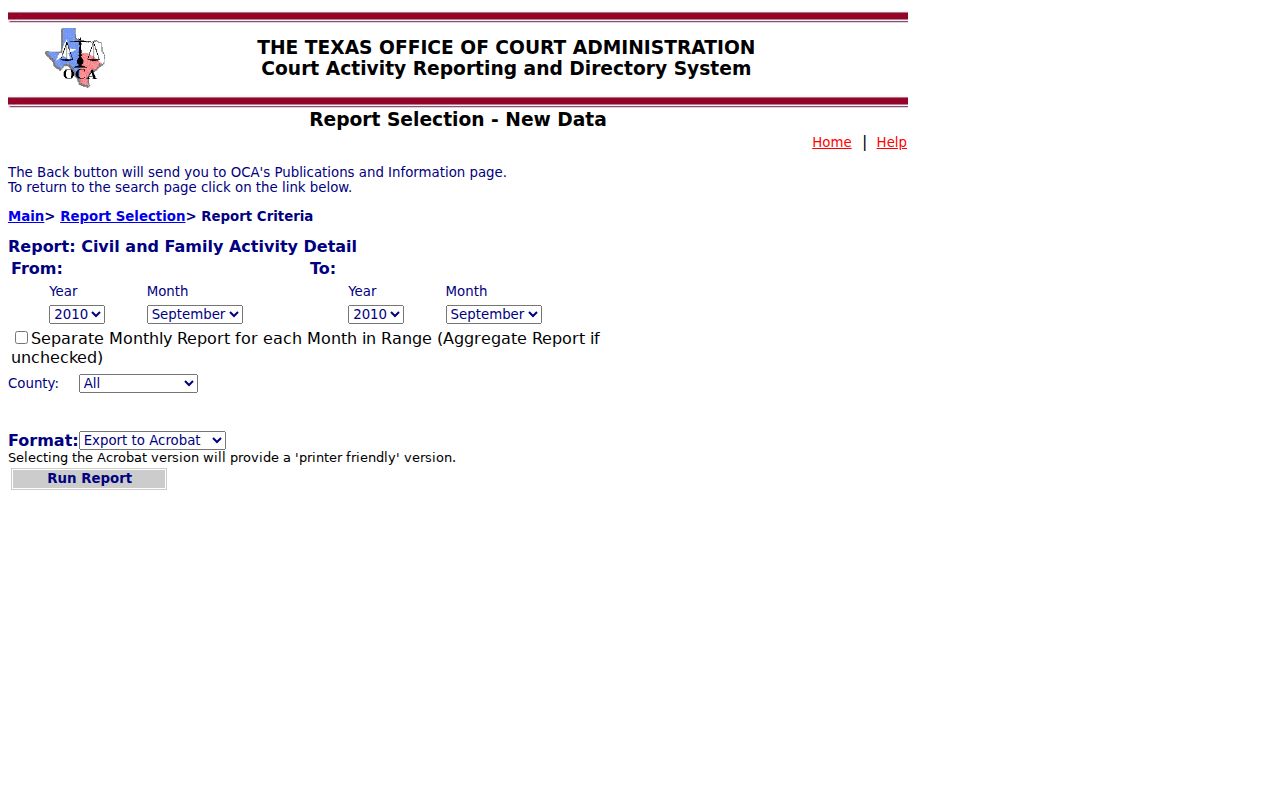
The OCA reporting screen is not a name search. Pick the county, court, report type, and time period to study aggregate activity. For an actual lawsuit, go back to Tyler, re:SearchTX, or the clerk. Keeping statistics and docket entries separate prevents easy confusion.
Lamar's Older Civil Minutes
Civil minutes from Lamar County's older terms of court do not always show up in a modern electronic index. The Texas State Library holds microfilm covering 6th District Court civil minutes from 1916 through 1927. These minutes record court actions in an older format. So the fields and images you expect from today's docket entries may not be there. For historical or family research, that span is often exactly what matters.
Local history explains the gaps. A fire in March 1916 destroyed much of downtown Paris along with the prior courthouse. Yet a records vault survived, per the Texas Historical Commission, and was later folded into the courthouse annex. The current courthouse went up in 1917. So an old civil docket entry missing online may still have a trail. Check the clerk's office, the archive, or microfilm. Survival, filming, and indexing are three different things.
Before asking the District Clerk for an old docket search, gather the volume, the court, and the year. Say the record sits on microfilm. Ask whether you can inspect it, get a scan, or have it certified. Also ask what citation details the office needs.