
Lamar County Court Record Requests
Figure out three things first: the court, the cause number, and the document you want. District Clerk Shawntel Golden holds the files of the 6th and 62nd District Courts. Those files cover felony, civil, family, and juvenile matters. County Clerk Ruth Sisson keeps County Court and County Court at Law records. Her office handles misdemeanors, civil suits, probate, and mental-health files. Justice and municipal courts keep their own lower-court papers.
Lamar County offers several ways in. The county Tyler link tracks criminal and civil case information. Re:SearchTX covers electronic filings statewide. You can also visit the right clerk at 119 N Main Street in Paris. Call 903-737-2420 for the County Clerk, or 903-737-2427 for the District Clerk. A written request by mail works too. The county lists fax lines but promises nothing about record requests sent that way. Confirm before relying on fax or email. Ask too whether a public computer terminal is open at the courthouse, since the county publishes no terminal location.
- Read the caption and identify the court that owns the file.
- Use the cause number to locate the Lamar County index entry.
- Name the exact pleading, order, judgment, or docket sheet needed.
- Tell the clerk whether the copy must be plain, electronic, or certified.
- Confirm the charge, payment method, delivery option, and current processing time.
Which Lamar County Clerk Has It?
Routing is everything here. Asking for a "Lamar County case" will stall your request. Two clerks and several courts each hold their own files. A felony indictment from District Court belongs to the District Clerk. A misdemeanor County Court file sits with the County Clerk. Justice of the Peace debt claims stay in the justice court. A Paris traffic citation stays with Paris Municipal Court.
District Clerk
119 N Main Street, Paris, TX 75460
903-737-2427
Monday through Friday, 8:00 a.m. to noon and 1:00 to 4:30 p.m.
County Clerk
119 N Main Street, Paris, TX 75460
903-737-2420
Monday through Friday, 8:00 a.m. to 4:30 p.m., with lunch from noon to 1:00 p.m.
Neither clerk posts a same-day cutoff or a standard turnaround for routine copies. Give your contact information and delivery preference, and let the office tell you what it can provide now.
Kinds of Court Records
A docket lists events; the case file holds the papers behind them. Depending on the case and access rules, a Lamar County file may hold the charging instrument or petition, service papers, answers, motions, hearing notices, signed orders, judgments, pleas, sentencing papers, and the docket sheet. Probate and family cases carry their own document sets, some of them restricted.
A court reporter's transcript is separate. For the 6th District Court, the county lists reporter Terry Spangler at 903-737-2432, and the OCA directory lists 62nd District reporter Anna Upchurch at 903-737-2434. Ask each reporter directly about transcript prices and turnaround. Probation records are not part of the court docket either, and neither the Juvenile Probation nor the Adult Probation office serves as a public record counter.
- Docket sheets and setting histories
- Pleadings, charging papers, and motions
- Notices, returns, and service records
- Signed orders, judgments, and dispositions
- Certified clerk copies and separate reporter transcripts
Lamar County Docket Versus Case File
The County Clerk's Tyler disclaimer likens its index to a library catalogue, a convenience rather than the record itself. That comparison is worth remembering. An index hit can surface the cause number, parties, court, status, and date. It cannot authenticate a pleading or prove every document image is online. Images can even drop out temporarily while backups run.
| Lamar County docket or index | Underlying court case file |
|---|---|
| Lists events, settings, and basic identifiers | Contains filed pleadings, orders, and judgments |
| Useful for locating and tracking a case | Used when the text of a document matters |
| May be a dated schedule snapshot | May include paper or electronic material not online |
| Not a certified record | Can be certified by the proper clerk |
Treat the docket as a map to the file. If an entry says an order was signed, ask for that order by date and title. If it lists a disposition, request the judgment itself whenever the exact terms matter.
Court Records: What They Contain
Sample sheets from the official Lamar County criminal docket show how much the fields vary. A District Court arraignment sheet lists hearing type, cause number, charge, file date, attorneys, bond data, and active status. A County Court docket can add a plea or disposition, fine, costs, jail days, credit, balance, and notes. Read those fields as clues. They never replace the file itself.
| Cause number | The identifier used to retrieve the correct Lamar County court record. |
|---|---|
| Case caption | The party style used to distinguish similar records. |
| Filed documents | Pleadings, charging papers, motions, notices, orders, and judgments. |
| Setting history | Arraignment, pretrial, plea, trial, or other hearing entries. |
| Disposition | The recorded outcome, which should be checked against a signed order. |
| Financial entries | Costs, fines, credits, or balances when the court record displays them. |
A blank field proves nothing. The detail may live in a document, a later entry, a separate clerk system, or a restricted part of the file.
Lamar County Certified Copy Steps
The clerk posts no case-copy request form on the County Clerk forms page or the District Clerk page. A written request aimed at one case is the dependable route. Spell out the court, the cause number, the full caption, and the rough filing date. Name the exact document you need and the certification you want. Then add your contact information and how you want it delivered. Before you send any payment, ask the clerk to quote the current total.
Certification means the clerk attaches an official certificate and seal. That is not the same as downloading a PDF or printing a docket index screen. A receiving office or a legal process may demand authenticated court records. A certified copy is what you need then. A plain copy works fine for reading a docket. It also works for keeping track of your own case.
Be exact: “Certified judgment entered on the known date” is easier to price and locate than a request for the complete case.
Note: Lamar County publishes no standard turnaround or universal payment list for ordinary court-record requests.
Copy Fees and Certification
Texas Government Code Section 51.318 and the Lamar County District Clerk fee sheet give the clearest published charges. Those are record and search fees, not filing fees. Confirm the total before you pay, because certification and page charges can stack, and a long electronic file changes price after its first ten pages.
| Service | Published amount | Source note |
|---|---|---|
| Search without a cause number | $5 | Texas Government Code §51.318 |
| Certificate and seal | $5 | Added to the page charge |
| Certified or plain paper page | $1 per page | Statute and Lamar fee sheet |
| Electronic document, pages 1 through 10 | $1 per document | Lamar District Clerk fee sheet |
| Electronic page 11 onward | $0.10 per page | Fee sheet and statute |
| Judgment abstract | $8 | Texas Government Code §51.318 |
| Certification of no appeal | $5 | Lamar fee sheet |
Filing a new case costs money in a different way. The $350 shown for certain District Clerk civil or family filings is not what you pay to view a docket or get a routine copy.
Lamar County Fee Data in Context
Numbers can mislead. They mislead if you treat them like a case file. The Texas Office of Court Administration publishes activity reports. The reports count filings across the courts. They show workload, not what happened to any one person. A misdemeanor report will never show a pleading, an order, or a single docket entry.
Open the official OCA misdemeanor activity source to view the report criteria yourself.
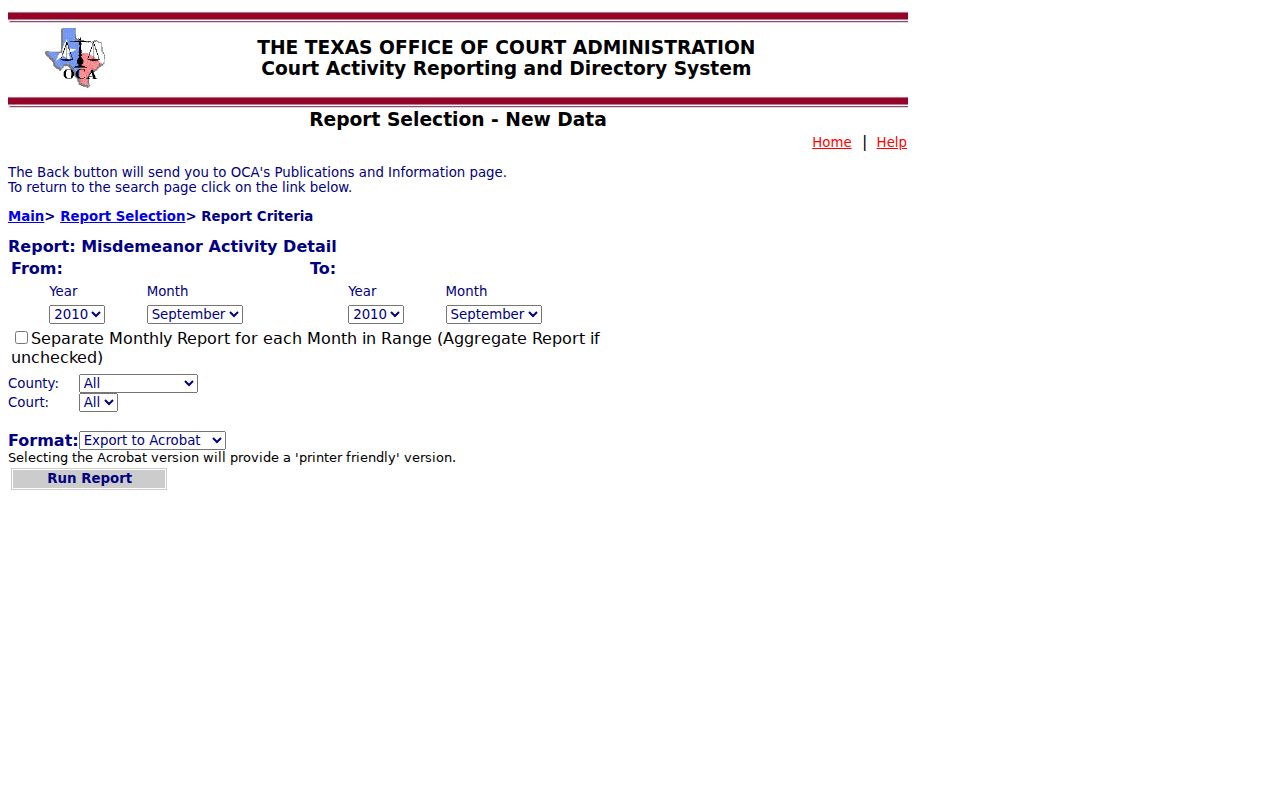
That distinction guards against a common mistake. Aggregate Lamar County totals describe court workload, while the clerk's case file documents one proceeding.
Access Rules for Court Records
Getting Texas court records works differently from requesting files from an executive agency. The Texas Judicial Branch open-records policy says courts are outside the Texas Public Information Act when it comes to adjudicative records. Texas Government Code Section 552.0035 points elsewhere. It sends you to Supreme Court rules and whatever other law applies. Rule of Judicial Administration 12 governs public inspection and copying of judicial records within its scope.
Case records are usually public. Still, limits exist. Texas Family Code Chapter 58 shields juvenile records. Texas Rule of Civil Procedure 76a handles sealing in civil cases. Redaction rules force sensitive data out of public filings. An expunction can erase qualifying criminal records through a court process. The local expunction sheet lists a $350 filing charge. It adds $25 for each listed agency without an email address. That is an expunction filing fee, though, not a public-copy fee.
Missing is not sealed: a result may be too new, too old, filed under another spelling, stored on paper, or held by another Lamar County court.
Lamar County Vault and Microfilm
Older Lamar County court records take a wider search. The 1916 Paris fire destroyed the former courthouse and much of downtown. Yet a records vault survived. It predated the earlier courthouse and was built into an annex. The present pink-granite courthouse went up in 1917 on the old foundation. That history explains why physical custody still matters here.
Microfilm fills some of the gap. The Texas State Library holds 6th District civil minutes from 1916 through 1927. If you want an early order or judgment, give the clerk the court, the parties, the date range, and the record series, then ask whether the item sits in the courthouse, on microfilm, or somewhere else. Do not assume the online index covers that era.
For a current file, start with a Lamar County docket search to find the cause number. For an old one, a direct call to the custodian often beats repeated online searching. Either way, the originating clerk issues an authenticated copy.