
How the Lamar County Court Calendar Works
No single calendar covers every trial setting in Lamar County. Nothing like that exists. The official docket directory has carried dated County Court criminal arraignment PDFs, and a District Court PDF separately listed an arraignment hearing with a later PTR date. Each file covers one court on one date. It is not a live countywide feed. Treat it as a start, not the last word.
Settings can also surface through the county Tyler Odyssey case record. The Hearings search in re:SearchTX offers another route. The county-linked Tyler portal has thrown access errors. Its calendar fields stay unknown. The statewide service requires an account. Coverage varies case by case. Whenever a screen conflicts with a notice, the issuing court gets the final say.
Misdemeanor, District felony, civil, Justice Court, and municipal matters each sit with a different clerk. That split is why a search by case type alone can miss a hearing. Identify the court first, then pick its calendar channel.
Posted Lamar Docket or Live Setting?
A dated docket PDF records what was ordered or assembled when the list was made. Nothing more. The County Court sample names the court and judge. It gives the courthouse address, date, time, and the cases set for arraignment. The District sample gives the judge and hearing time. It adds an arraignment label and a future pretrial-related date. All of it helps when you are piecing the schedule back together.
| Source | Best use | Main limit |
|---|---|---|
| Dated docket PDF | See the posted court call and listed cases | May not show a later reset |
| Tyler case entry | Review case events when available | Portal access and display can vary |
| re:SearchTX Hearings | Check statewide electronic data | Account and coverage limits apply |
| Clerk, coordinator, or attorney | Confirm a time-sensitive appearance | Call during the correct office hours |
A historical schedule proves one thing: a date was posted. It cannot prove the hearing happened, the case resolved, or that no later order moved the date. So save the source date and access date any time you record a setting for research.
Lamar County Court Date Lookups
Begin with the paper that created the duty to appear. A citation points to the Justice or municipal court. A bond sheet or criminal notice should name the county or District Court. Civil pleadings and scheduling orders carry both a court and a cause number. Keep the full case number, punctuation and all. It searches far better than a common name.
- Identify the court from the citation, notice, bond paper, or pleading.
- Check the official Lamar docket directory for a matching court and date.
- Search the county judicial-records link or the re:SearchTX Hearings area.
- Read the PDF header and the individual setting line, not just its filename.
- Compare the result with the latest filed notice or scheduling order.
- Confirm the date, time, room, and setting type with the clerk, coordinator, or attorney.
Phone confirmation is quick once you know the court. The District Clerk is 903-737-2427. The 6th District Court line is 903-737-2432, and the 62nd District Court line is 903-737-2433. County Clerk records can be checked at 903-737-2420. County Court at Law lists 903-782-1104. If you have a lawyer, call counsel too, since attorneys often hold the newest notice.
Lamar's Civic Calendar Is Different
The county's public calendar is a civic-event tool, not an all-court schedule. You can sort by List, Week, or Month. The controls also let you set start and end dates, run search terms, show past events, pick a calendar, and move month to month. The events you will mostly see there are things like Commissioners Court meetings. None of that makes it a hearing calendar. It is not a District, County, Justice, or municipal schedule for Lamar County.
The official capture below shows the calendar interface a visitor encounters. It works well for county events. A court appearance still has to be checked through the case docket or the issuing court.
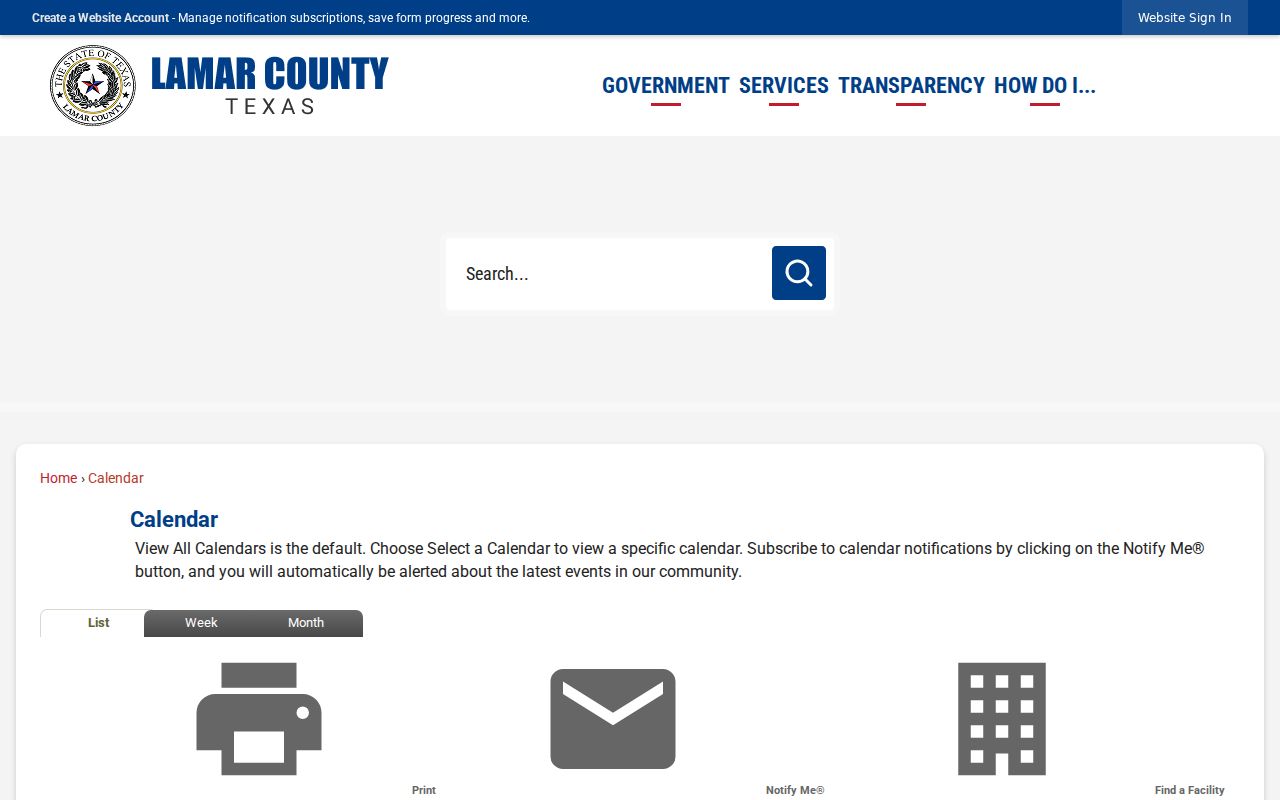
The distinction matters because it prevents a costly mistake. A blank civic-calendar day does not mean no arraignment, motion hearing, trial, or docket call is set elsewhere in Lamar County.
Court Settings: What Each Field Means
Every setting line pairs identifiers with scheduling facts. Read the header first. It supplies the court, judge, docket type, and overall call time. Then match the cause number and case style on the row itself. The charge or claim tells you what the matter is about. The hearing label explains the reason for that date.
| Date | The posted calendar date, subject to a later order or reset. |
|---|---|
| Time | The docket-call or hearing time; it may not predict when one case will be reached. |
| Court | The numbered District, county, Justice, or municipal court holding the setting. |
| Location | The building or courtroom stated on the current notice; confirm before travel. |
| Setting type | Arraignment, PTR, motion, announcement, trial, sentencing, review, or another event. |
| Judge | The judicial officer associated with the posted docket, which can change by assignment. |
A "setting" is just a date and time assignment, never proof a hearing took place. "Arraignment" is the criminal appearance. The charge and plea process happens there. PTR showed up in the District sample as a later pretrial-related setting. Lamar has published no complete abbreviation key. Have the clerk or your notice confirm any unfamiliar shorthand.
Monday Trial-Week Rules in Lamar
The official Lamar District Court rules add local timing. No basic calendar screen can explain it. Pretrial matters, announcements, continuances, motions, exceptions, and other preliminary issues must be presented or heard no later than 9:00 a.m. Monday of trial week. The court may set an earlier time. Jury assignment runs by week, and cases are taken in setting order.
The judge makes all settings. The District Clerk notifies the interested attorneys. A trial setting can be canceled only with the court's consent. After pretrial day, the court will not grant a continuance. The cause must have been unknown, and it must not reasonably have been foreseen. That makes a scheduling order and attorney notice worth far more than any assumption drawn from a public list.
Monday is not automatically the trial time. It can be the deadline or call for preliminary matters during trial week. Read the actual notice and confirm the assigned appearance.
When a Court Date Moves
Court dates move in three distinct ways, and each label means something different. A reset gives the case a brand-new date. A continuance pushes a proceeding later by order of the court. A cancellation wipes a setting off the calendar. Lamar District rules still demand court consent before a trial setting can be canceled. A blank search result or a missing docket PDF never proves any of these happened. Whatever order, notice, or clerk record was filed most recently is the one that controls.
Set the public entry next to the latest filed notice before drawing any conclusion. Ask one plain question. Is the setting current, reset, canceled, or governed by some other order? Write down the office name, the confirmation date, and the exact wording the clerk used. If a lawyer represents the party, that lawyer should make the call. The District Clerk routes notices to attorneys of record. County Court at Law matters go elsewhere. They run through the County Clerk or the County Court at Law line.
A setting can move after a docket PDF goes up. The stale file still has value as a historical snapshot. It cannot excuse an appearance. A vendor payment screen proves payment, not a reset.
Lamar Arraignment and PTR Labels
One Lamar County court file shows what a criminal arraignment docket looks like in practice. Each row pairs a hearing time with case basics. You see the charge, the attorney, and bond details. A memo line and jail days sit alongside them. The District Court sample works the same way. It labels an Arraignment Hearing and adds a later PTR date, so a single docket row can mix the day's schedule with a short case and custody snapshot.
- Arraignment
- A criminal appearance addressing the accusation and plea process, not a trial result.
- PTR
- Pretrial-related shorthand displayed in the District sample; verify the exact meaning for the case.
- Docket call
- A group setting at which several cases may be called.
- Motion hearing
- A setting for a request that the judge decide a specific issue.
- Trial setting
- A scheduled trial position that remains subject to court orders and local rules.
Read the labels with care. The bond amount is not a fine, and "Active" in a bond-status field is not a disposition. A hearing label says nothing about guilt or who prevailed. The filed judgment or order holds the outcome.
Missed Settings and What Comes Next
Move fast after a missed setting. Call the attorney and the court named on the notice right away. Ask whether the judge set a new date. Also ask whether the judge issued a failure-to-appear action, a bond order, a warrant, a default, or some other directive. The clerk can walk you through the public record and the filing procedure. Legal strategy is not the clerk's role.
Missed a setting? A criminal absence can lead to failure-to-appear consequences, a warrant, or bond action, while a civil absence can cause orders or default-related action.
Call the responsible clerk or attorney at once and ask for the current docket entry and any signed order.
Consult a licensed attorney about the legal effect of a missed Lamar County setting before appearing or filing a response.
The county's civic calendar cannot tell you what happened in a case. Go to the case register and the signed order instead. Justice Court and municipal matters sit with those specific offices, since the County and District Clerks may not hold their schedules.
Before Traveling to Lamar Court
Most county trial-court and clerk listings point to the Lamar County Courthouse at 119 N. Main Street in Paris, with the District Courts listed on the second floor. Beyond that, the county publishes no courtroom map, parking arrangement, security policy, public-transit route, recording rule, or public computer location. A phone call beats an assumption every time.
Before you drive, confirm the date, the call time, and the courtroom or floor, and ask whether the matter is in person. Raise accessibility or interpreter needs directly with the court. Pack the cause number and the current notice. The County Clerk posts hours of 8:00 a.m. to 4:30 p.m. with a noon-to-1:00 closure, while the District Clerk lists 8:00 a.m. to noon and 1:00 to 4:30 p.m. Holiday closures and same-day service are worth confirming too.
City cases meet elsewhere. Paris Municipal Court sits at 2910 Clarksville Street, and Reno Municipal Court at 160 Blackburn Street. Blossom and Roxton publish their own city-court contacts. For routing, nothing beats the citation itself.
Lower-Court Dates Across Lamar
Justice and municipal calendars live apart from the District and county dockets in Lamar. The county lists six Justice Court places. JP Precinct 5 Place 1 offers an online citation search and payment route. Entry options cover citation number, driver license and birth date, Social Security number, plate, name, and business name. Fresh citations may not have reached the office yet, and some matters stay offline entirely.
Paris Municipal Court links a TrafficPayment vendor for citation payments. Reno posts its own court, payment, and record-search instructions. Blossom lists a municipal court phone. Roxton holds court at City Hall and names the JP Precinct 2 contact. Deport's official city site offers no municipal docket portal. Treat none of these payment routes as a full case calendar.
For any lower-court setting, call the court printed on the citation. Confirm the online date is current. Then ask whether an appearance, payment, plea, course request, or other action is due. See Lamar County Traffic Court for citation routing.
Lamar Hearing Research Worksheet
A short worksheet keeps two courts or two versions of a setting from blurring together. Record the full cause number, case style, court, judge if shown, hearing date, time, setting type, location, source URL or notice title, source date, and access date. Add one more field for the latest clerk or attorney confirmation.
- Court and complete cause number
- Posted date, time, and setting label
- Current room or appearance instructions
- Source date and date accessed
- Clerk, coordinator, counsel, or court confirmation
Keep posted facts separate from confirmed facts. Until the office verifies a setting is still active, write "arraignment listed on the dated County Court PDF". Stop there. A hearing only happened if the later docket or order says so. That discipline matters most for old PDFs still sitting in a public directory.
Skip personal identifiers from a docket. Keep them only if the notes truly need them. Juvenile, sealed, and protected matters may never appear publicly. And a missing public setting never outweighs a direct notice from the court.